
Shopify: publish articles and add product schema
Connect Shopify with an Admin API token to publish blog articles and write a video's structured data into a product metafield.
The Shopify connector covers two lanes. The blog lane publishes an approved Framesite page as an unpublished blog article. The catalog lane reads your product catalog to ground product truth and can write a video's structured data into a product metafield. Both authenticate with a Shopify Admin API access token from a Custom App.
What you need
A Custom App Admin API access token, your myshopify.com store domain, and, for the blog lane, the numeric Blog ID of the blog you want articles in. Create the Custom App and its Admin API token in your Shopify admin under Settings then Apps and sales channels then Develop apps. Grant the blog write scope for publishing and the Products read and write scope for schema write-back; a read-only token is refused. Connecting requires a workspace admin.
Connecting Shopify
Open the Shopify card
In Framesite, open Settings, then Destinations & connections, and find the Shopify card. Connecting destinations is limited to workspace admins.
Enter your details
Paste the Admin API access token, your myshopify.com store domain, and the numeric Blog ID for the blog lane.
In Framesite- Settings
- Destinations & connections
- Shopify
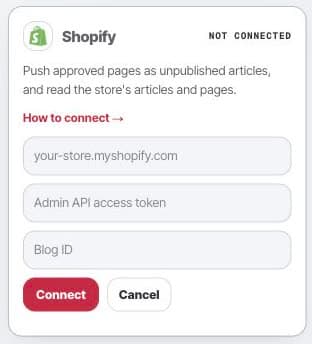
The publishing connection sends approved pages to the Shopify blog you choose as unpublished articles. Save the connection
The token is stored encrypted in our vault and is never displayed again. It only works against your own store.
Connecting the product catalog
Open the Shopify catalog card
Stay in Destinations & connections, then find Shopify catalog under Store catalogs. This connection is separate from blog publishing so you can use either lane on its own.
Enter your catalog details
Paste the myshopify.com store domain and an Admin API token with the Products read and write scope.
In Framesite- Settings
- Destinations & connections
- Shopify catalog
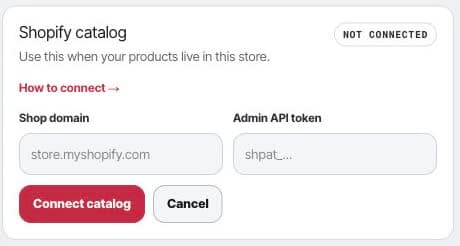
The separate store catalog connection grounds product truth and supports product schema write-back. Save the catalog connection
Framesite validates the store before saving the token encrypted and reading the product catalog.
What it does
Blog lane. When you approve a page, Framesite publishes it as an unpublished blog article in the blog you named. Re-syncing the same page updates the same article rather than creating a duplicate. It does not make the article live; you publish it in Shopify.
Catalog and schema lane.Framesite reads your product catalog, which is SKU-authoritative, to ground product truth, and can write a video's structured data into a product metafield in the framesite namespace under the key video_schema. A small one-time theme snippet renders that metafield server-side, so the product page carries the schema.
Troubleshooting
- A 403 on schema write-back. The token is missing the Products modify scope. Update the Custom App to grant Products read and write, then reconnect.
- The token does not work. An Admin token only works against your own myshopify.com store. Confirm the store domain matches the token.
- The connect button says denied. Connecting is limited to workspace admins. Ask a workspace admin to connect, or to make you an admin.
Removing the connection
Open the Shopify card and click Disconnect. This removes the stored token from our systems immediately and ends all further access. Blog articles you already published and metafields already written stay in Shopify until you remove them yourself. Reconnecting later starts from a fresh token.
Common questions
- Does Framesite publish live blog articles?
- No. An approved page lands as an unpublished blog article in Shopify. It stays hidden until you publish it yourself.
- What scopes does the token need?
- Blog publishing needs the blog write scope. Catalog schema write-back needs the Products read and write scope. A read-only token is refused, because Framesite cannot write the product metafield without write access.
- How does the product schema reach my store?
- Framesite writes a video's structured data into a product metafield in the framesite namespace under the key video_schema. A small one-time theme snippet renders that metafield server-side, so the product page carries the schema.
- What stays if I disconnect?
- Disconnecting removes the stored token. Blog articles you already published and metafields already written stay in Shopify until you remove them.